






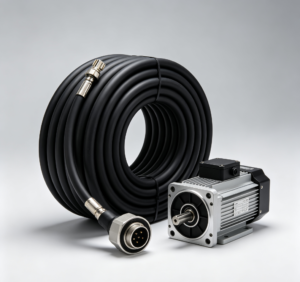
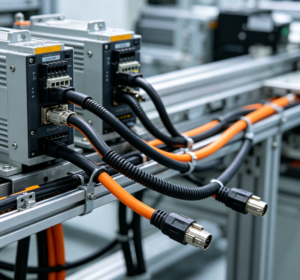
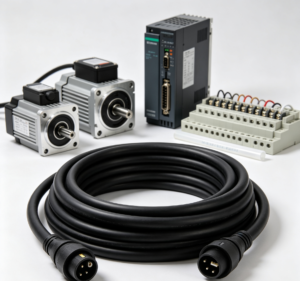
High Temperature Servo Motor Silicone Cable | Flexible Power Supply Cable for Motion Control Equipment
The failure pattern that shows up on servo motor power cables
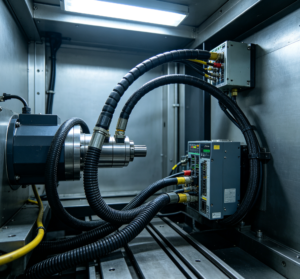
Pull a servo motor power cable off a machine after a couple of years of continuous duty cycling, and the damage is rarely random. It clusters at two points: right where the cable exits the motor housing (repeated flex fatigue at a fixed pinch point), and along any section that runs close to the motor body itself (thermal degradation from motor case heat, which can run considerably hotter than the surrounding cabinet air). A cable that’s rated for high temperature but not built for the flexing, or built for flexing but not rated for the heat, tends to fail at exactly one of those two points — just at different speeds.
This servo motor silicone cable line is built around addressing both failure points in the same construction, rather than treating them as separate problems solved by separate product lines. That’s the practical reason silicone shows up here instead of PVC or standard rubber: it’s one of the few jacket materials that holds up to sustained motor-case heat and stays flexible enough to survive a fixed-point flex zone without going brittle.
Where this cable fits — and where it doesn’t
A good fit when:
- the cable exits directly from or near a servo motor housing that runs hot under continuous load
- there’s a fixed flex point (motor exit, cable clamp, strain relief) that sees repeated but limited-range movement — not full drag-chain travel
- the installation needs a jacket that won’t stiffen and crack from years of motor-case radiant heat, even if the cable itself isn’t constantly moving
Not the right choice when:
- the cable travels the full length of a drag chain with millions of reciprocating cycles — that’s a dedicated drag-chain conductor and stranding design, and using a motor power cable in that role usually shows up as conductor fatigue well before the jacket is the limiting factor
- you need integrated encoder/feedback conductors in the same jacket — this is a power-only line; combined power-and-signal servo cables are a separate construction with internal shielding and pair-twisting that a straight power cable doesn’t have
- the application is outdoor and subject to long-term direct UV exposure without any shielding — ask about jacket compound options for that case specifically, since not all silicone compounds handle UV identically
What actually determines the right conductor size — and it isn’t just current
Servo motor cabling is one of the few places where undersizing a conductor causes a problem that’s easy to miss during initial commissioning and only shows up months later: voltage drop under acceleration current. Servo motors draw peak current well above their continuous rating during acceleration and deceleration, and if the cable run is long, that peak current through an undersized conductor can cause enough voltage drop to trigger intermittent fault codes under load — faults that often get chased as a drive problem or a motor problem before anyone checks the cable.
The practical implication: conductor sizing for servo power cable should be checked against peak acceleration current and cable length together, not just continuous current draw. A cable that’s adequate at rest and under steady load can still be undersized for the actual duty cycle.
Construction
| Element | Detail |
|---|---|
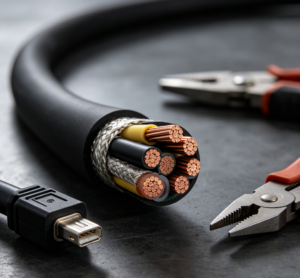
| Conductor | Fine-strand tinned copper, IEC 60228 Class 5/6 |
| Insulation | Silicone rubber |
| Core arrangement | 3 or 4 power cores + ground, stranded lay (twisted, not parallel) |
| Jacket | Silicone rubber, abrasion-resistant compound |
| Cross-section range | 0.75 mm² – 16 mm² |
| Voltage rating | 450/750V standard; higher ratings available on request |
| Temperature rating | -60°C to +200°C per DIN EN 50305 |
| Flex rating (fixed flex point use) | Rated for repeated bending at a defined pinch point — not continuous travel duty |
| Jacket property | Oil and abrasion resistant per DIN EN 60811 |
The twisted core lay (rather than parallel cores) matters more for servo cable than it does for simple control wiring — it reduces electromagnetic asymmetry between the power conductors, which has a secondary effect on motor bearing current and EMI radiated from the cable itself. It’s a small construction detail, but it’s part of why a purpose-built servo cable behaves differently from a generic multi-core power cable of the same gauge.
A sizing example, worked through
A common scenario: a servo motor rated for 3kW continuous, mounted on a robot base with a 12-meter cable run back to the drive, cable routed along a fixed conduit with one flex point at the motor exit (motor rotates with the joint, cable does not travel a chain).
- Continuous current for the motor alone might size a 2.5 mm² conductor comfortably
- Peak acceleration current, which can run 2–3× the continuous rating for short bursts during rapid moves, combined with the 12-meter run length, pushed the practical selection up to 4 mm² to keep voltage drop under acceleration within the drive manufacturer’s tolerance
- Jacket was specified in silicone rather than PVC because the motor housing surface temperature under continuous duty ran above 90°C, and the cable’s fixed routing passed within a few centimeters of the housing for part of its run
- Flex point handling: because this is a fixed-point flex (motor rotates, cable doesn’t travel a chain), a standard stranded conductor was sufficient — a full drag-chain-rated conductor construction wasn’t necessary here, which also kept cost down
The resulting spec: 4 cores (3 power + ground) × 4 mm², silicone jacket, 15 meters (with margin for routing).
The point of walking through this isn’t the specific numbers — it’s that the two decisions that mattered (conductor size, jacket material) were driven by acceleration current and housing temperature respectively, not by the motor’s nameplate rating alone.
Silicone Servo Cable vs Standard Rubber Servo Cable
| Silicone Jacket | Standard Rubber (EPR/CPE) Jacket | |
|---|---|---|
| Continuous exposure near hot motor housings | Holds flexibility for years | Progressively stiffens, cracking risk increases over time |
| Cold-weather handling | Stays pliable well below freezing | Stiffens noticeably in cold storage or outdoor cold starts |
| Cost | Generally higher material cost | Generally lower |
| Best fit | Motor-adjacent routing, wide temperature swings | Moderate-temperature applications with cost sensitivity |
Neither is a wrong choice in general — the decision point is almost always the actual housing/ambient temperature the cable will see in service, not a blanket preference for one material.
Questions that come up during specification
Our servo drive throws intermittent faults only during rapid moves, not at steady speed. Could the cable be the cause? It’s worth checking conductor sizing against peak acceleration current and cable run length before assuming it’s a drive or motor issue — this is a more common root cause than it initially appears, especially on longer cable runs.
Can this cable be used in a drag chain since it already handles bending at the motor exit? Not reliably for full drag-chain duty. A fixed-point flex zone and continuous travel through a chain put very different fatigue loads on the conductor strand construction — a cable rated for one isn’t automatically rated for the other.
Do we need the twisted core lay, or is parallel construction fine for our application? If bearing current or EMI hasn’t been a problem on your existing setup, parallel construction may be acceptable. Twisted lay becomes more important as cable length increases or when the installation already has known EMI sensitivity nearby.
What temperature does the motor housing actually need to reach before silicone becomes necessary over standard rubber? There’s no universal cutoff, but housing surface temperatures consistently above roughly 80–90°C are where standard rubber jackets start showing accelerated aging in field experience, which is the point where silicone’s cost premium typically becomes justified.
Can this be supplied with pre-terminated connectors matching our servo drive’s motor-side plug? Yes — connector assembly is available as a made-to-order option; connector type and pinout need to be confirmed against your specific drive/motor combination.
Getting a working quote
The details that actually determine the build: motor’s continuous and peak acceleration current, cable run length, whether the installation is fixed-flex-point or full drag-chain travel, and the actual housing/ambient temperature the cable will be routed near. A worked example like the one above, even a rough version, usually gets to an accurate quote faster than a generic spec request.
[Request a Quotation] · [Ask an Engineer Before You Spec It] ·