









Sensor-Silikon-Signalkabel | Flexible Bewegungskabel für Robotik- und Automatisierungsanlagen
Field Reference — Sensor & Signal Cabling for Moving Automation Equipment
The three symptoms that usually point back to the signal cable
Before specifying a new sensor cable, it’s worth recognizing the failure signature it’s meant to prevent. On robots and moving automation equipment, sensor signal problems tend to show up as one of three symptoms — and all three are frequently misdiagnosed as sensor or controller faults before anyone checks the cable itself:
- Intermittent dropout that correlates with motion, not time — a sensor reading blinks out only when the arm moves through a specific position, then returns to normal at rest. This usually points to a conductor fatigue crack that only opens the circuit under flex, not a sensor malfunction.
- False triggers correlating with nearby motor activity — a proximity sensor or encoder reads noise spikes specifically when an adjacent servo drive ramps up. This is a shielding or grounding issue, not a sensor calibration problem.
- Signal degradation over long cable runs — encoder pulse edges soften or count errors appear only on longer machines. This is a cable capacitance/impedance issue as much as a cable damage issue.
Dies sensor silicone signal cable line is built to address the first two directly (fatigue resistance under repeated flex, shielding against motor-adjacent EMI); the third is partly a cable property and partly a system design question, addressed further down.
Where this cable belongs
Specify this cable when:
- sensor or signal wiring travels through a robot arm joint, a moving axis, or any point that flexes repeatedly during normal operation
- signal runs are routed near servo drives, VFDs, or other motor circuits and need shielding against induced noise
- the installation environment runs hot enough that standard PVC signal cable’s practical service ceiling becomes a real constraint (near motor housings, inside heated enclosures)
Don’t default to this cable when:
- the signal is a defined-impedance protocol (industrial Ethernet, certain high-speed fieldbus variants) — those need cable built to a specific impedance spec, not a general-purpose shielded signal cable, even a well-made one
- the run is entirely fixed and stationary in a cool cabinet — a lower-cost standard shielded cable likely performs identically at lower cost
- extremely long runs (tens of meters) are carrying high-frequency encoder signals — at that point, signal integrity is often better solved with a driver/receiver or repeater strategy than with cable selection alone
Diagnosing which property actually matters for your application
Rather than listing every spec up front, it’s more useful to work backward from what’s actually failing or at risk:
If the concern is flex fatigue: the conductor strand count and stranding pattern matter more than jacket material alone. A cable with the right temperature rating but a coarse stranding will still crack at a flex point faster than a fine-strand construction rated for dynamic use. Check IEC 60228 conductor class, not just voltage/temperature numbers, when flex life is the priority.
If the concern is EMI-induced false triggers: shield coverage and termination method matter more than shield presence alone. A braided shield with proper 360° termination at both ends outperforms the same braid pigtailed at one end by a wide margin — often a bigger factor than which cable brand is chosen.
If the concern is signal integrity over distance: this is where cable selection has real but limited influence. Twisted-pair construction for differential signals (common on many encoder outputs) helps reject common-mode noise over distance, but beyond a certain run length, the fix shifts from “better cable” to “add a line driver/repeater” or “move the drive electronics closer to the sensor.” A cable spec sheet won’t solve a system-level signal budget problem by itself.
Bauwesen
| Element | Spezifikation |
|---|---|
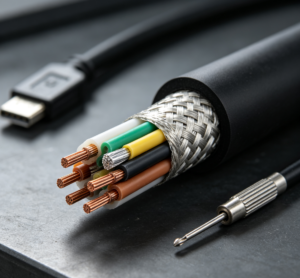
| Dirigent | Fine-strand tinned copper, IEC 60228 Class 6 (dynamic-flex grade) |
| Pair construction | Twisted pair standard on differential-signal variants |
| Isolierung | Silikonkautschuk |
| Shield | Tinned copper braid, ≥85% coverage (foil + drain on lower-EMI variants) |
| Jacke | Silicone rubber, abrasion-resistant |
| Anzahl der Kerne | 2–12 conductors / 1–4 twisted pairs |
| Querschnittsbereich | 0.14 mm² – 0.5 mm² |
| Nennspannung | 300/300V typical (signal-duty, not power) |
| Temperaturbereich | -60 °C bis +200 °C gemäß DIN EN 50305 |
| Flex duty | Rated for repeated dynamic flexing (robot joints, moving axes) |
Signal Cable vs Standard Shielded PVC Signal Cable
| Entscheidungsfaktor | Silicone Signal Cable | Standard Shielded PVC |
|---|---|---|
| Repeated dynamic flexing (robot joints) | Fine-strand construction built for flex fatigue resistance | Coarser stranding, shorter flex life at the same bend radius |
| Near-motor heat exposure | Stable well above PVC’s practical limit | Degrades faster above ~70°C sustained |
| Flexibilität bei niedrigen Umgebungstemperaturen | Stays pliable in cold storage/startup | Stiffens, increasing crack risk at flex points in cold conditions |
| Kosten | Höher | Nach unten |
| Optimale Passform | Moving joints, hot zones near motors | Fixed signal runs in moderate, stationary conditions |
If the installation is stationary and the ambient temperature is moderate, the flex-fatigue and heat advantages of silicone construction may not justify the cost difference — this table is meant to help rule the cable out as much as in.
A troubleshooting scenario, worked through
A recurring pattern worth naming rather than a specific verified case: a robot arm’s wrist-mounted proximity sensor reports intermittent dropout, but only during the wrist’s rotation motion, not when the arm is stationary at any position — including the same rotational position reached from a different path. The dropout correlating specifically with motion through the flex zone (not with position, orientation, or time) is a strong indicator of a conductor fatigue crack at the joint’s flex point, rather than a sensor or connector seating issue. Standard diagnostic sequence: check continuity while manually flexing the cable at the joint before replacing the sensor.
Häufig gestellte Fragen
Our proximity sensor drops out only during arm motion through one specific joint — is this a cable issue? This pattern — dropout correlating with motion through a flex point rather than with position or time — is a common signature of conductor fatigue at that flex zone. Checking continuity while manually flexing the cable at the joint is a useful diagnostic step before replacing the sensor.
Do we need shielded cable if our sensors are far from any motor or drive? Not necessarily. Shielding matters most when signal runs are routed near or parallel to motor power cables or VFD output. If the run is isolated from those sources, an unshielded fine-strand silicone signal cable may be sufficient.
Can this cable handle high-speed industrial Ethernet signals? No — defined-impedance data protocols need cable built to that specific impedance spec. This is a general-purpose shielded signal/sensor cable, not a certified Ethernet cable, even though both may be described as “shielded.”
Our encoder signal degrades only on our longest machine variant — is a better cable the fix? Possibly, but not always. Beyond a certain run length, signal integrity is often better addressed by adding a line driver/repeater or reconsidering drive electronics placement than by cable selection alone — this becomes a system design question rather than a pure cable spec question.
What core count and shielding options are available for custom sensor harnesses? Configurations from 2 to 12 conductors (or 1–4 twisted pairs) with braided or foil shielding are available as made-to-order builds; core count and shield type are specified per application rather than chosen from a fixed catalog.
Checkliste für die Spezifikation im Rahmen eines Angebots
- Number of sensors/signals and conductor count needed
- Signal type — digital on/off, analog, or differential/encoder pulse
- Whether the cable routes through a moving joint or flex point (and approximate flex range)
- Proximity to motor/drive power cabling (for shielding decision)
- Cable run length
[Angebot anfordern] · [Fragen Sie einen Ingenieur, bevor Sie die Spezifikationen festlegen] ·